
Join and handover
Care Instructions for NDIS Support Workers: Keep the Current Version Easy to Find
Help workers find the current care instructions by agreeing the source with the person responsible for it, checking access where support happens and naming who has accepted the work of updating each copy. When an instruction changes, confirm when it takes effect, tell the people affected and check what they need before using it.
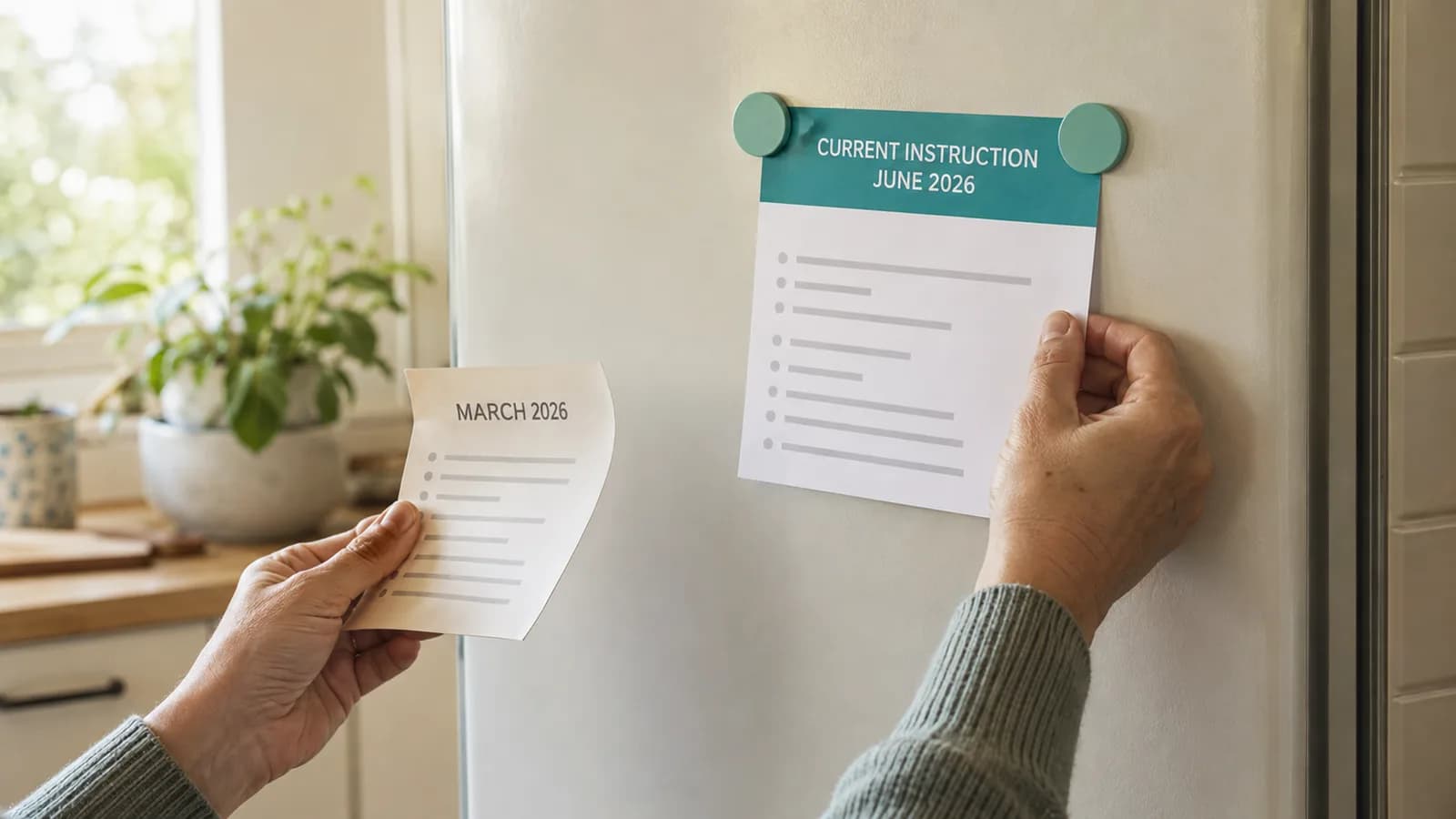
A short card on the fridge or beside equipment can help someone reach that source. It is optional: a clearly maintained provider system, folder or controlled paper copy may already do the job. Use the card and change note below where they help, without a Kinovo account.
Here, care instructions means the relevant support plan, professional instructions and agreed practical guidance for the task. It does not mean the NDIS funding plan. A summary should lead to the full information the worker needs, alongside the preparation, training and supervision required for that support.
- For:
- NDIS participants, chosen supporters, families, workers, coordinators and providers sharing care instructions
- Includes:
- Current-source card + instruction-change note + handover checklist + PDF and editable text
- Time:
- 13 minute read
Published 8 September 2026 · Updated 23 October 2026
Written by Callum Cruikshank — Founder of Kinovo
Callum draws on his family's lived experience of coordinating support. These resources offer practical coordination ideas, not clinical, legal or NDIS funding advice. No independent clinical review is claimed.
Choose a practical tool
Copy the current-source card and instruction-change note, or download both as a printable PDF or editable text. Use them with the participant and people responsible for the source and working copies. Add the detail the support needs; no account is required.
Confirm which instruction applies to this support
Ask the practitioner or provider responsible for the instruction to confirm the full source, its author or issuing organisation, version or reference if supplied, and when it applies. Involve the participant with the support they need. A newer upload, recent email or familiar printed sheet does not by itself establish which instruction to use.
Keep issue, effective and review dates distinct. The issue date tells you when a document was issued; the effective date, where specified, tells you when it applies. A review date prompts a check and does not by itself establish whether a plan is still appropriate. If the start time, version or current status is unclear, ask the responsible person rather than inventing it. You can label your own working copy for tracking without pretending that label came from the clinician.
For registered providers, the applicable Practice Standards depend on their registration and supports. Where the core Support Planning standard applies, the Commission's guidance addresses accessible plans and workers understanding them. These version and copy checks are practical coordination suggestions, not prescribed NDIS document fields.
See the Commission's core support-planning guidance for those requirements. For mealtime management where the relevant standard applies, its supports-environment guidance requires the plan to be available where support is provided and easily accessible to the workers providing it.
The mealtime-management requirements also address worker understanding and training. A card, QR code or selected paragraph should not replace the full relevant plan or task-specific preparation.
Agree the reminder and the work of maintaining it
Ask what would help at the point of support. A card might simply identify the current plan, where to open it and who to contact. If a reminder includes an instruction, have the responsible practitioner or provider confirm that wording against the source. Where a task cannot be safely summarised, use a pointer to the full plan and keep it accessible.
Agree who confirms the professional source, who maintains each working copy, who tells affected workers and who checks access and any further preparation. Ask those people to accept their part and agree the timing. The same person need not do everything, and a participant or family member should not become responsible for every provider's records by default.
Give the card its own date or revision so it can be distinguished from an old card. Keep that separate from the source's version and effective date. Agree where the card will be used, who can see it and how the participant can ask for a correction. Include the full detail needed in the appropriate private record rather than shortening it to fit the card.
If the information is about how someone communicates, compare a communication passport, participant profile and care plan before deciding which current document or reminder is useful.
Copyable current-source card
Prepare this with the participant and the people responsible for the source. Use it as an agreed reminder and route to the full instructions. Add detail or use a separate private record where needed.
Current care instruction aid for [name or agreed reference] - [support task]
Prepared with [participant / chosen decision support / representative and scope, where relevant]
Source confirmed by [responsible practitioner or provider / role / contact] on [date]
Full source [title / author or provider / version or reference if supplied]
Source applies from [confirmed date or timing / if unclear, who is clarifying it]
Card version or local reference [ID / revision] - card checked on [date]
Working-copy updates accepted by [person or role / contact]
Agreed reminder or pointer [wording confirmed against the source; do not invent or alter clinical steps]
Full current instructions [exact private location / link or labelled folder / how the intended worker opens them]
Offline access if needed [current controlled copy / location / who replaces it and how changes reach this copy]
If a copy conflicts, is missing or cannot be opened, contact [responsible person / appropriate clinical contact / fallback] before the affected task.
Necessary support while clarification is pending [confirmed safe arrangement / who is arranging it]. Do not guess an instruction or leave the person unsupported.
For an urgent concern use [agreed immediate or emergency route]. Do not wait for an ordinary message reply.
After a change [who replaces working copies / tells affected workers / checks access, understanding and any required training before use]
This card supports coordination. It does not replace the full relevant source, worker preparation or professional records.
Before a new card is used
Confirm and make accessible
- Confirm the source, reference if supplied and when it applies with the responsible practitioner or provider. Keep unclear details marked for clarification.
- Agree any reminder with the participant, using the support they need, and the person responsible for the instruction. Check the intended readers and what can be displayed.
- Check authorised workers can open the full current source where support happens, including the controlled offline copy if needed.
Replace and hand over
- Distinguish the card's own revision from the source. Confirm who accepted each copy update and the handover, and when the change takes effect.
- Replace superseded working copies at the right time and tell affected workers and providers, including cover. Retain required history in the appropriate records.
- Check access, understanding and any required training before the affected support. If a step is missing, arrange clarification and safe necessary support with the responsible people.
Removing an old copy from use is different from deleting a record that must be retained. Ask each provider how it keeps required history in its records and prevents an old working copy being mistaken for current guidance. The Commission's core information-management guidance covers current, confidential information and appropriate records processes where those standards apply.
For worker learning, the Commission's Training your workers guidance explains the provider's role. For the wider first-shift preparation, use the new-worker handover below.
Copyable instruction-change note
Use this after the responsible person has confirmed the change. Send sensitive information through the agreed suitable channel, then check the handover result.
Subject: [support task] - confirmed change to [source / reference], applies from [date or timing]
Hi [worker / provider / relevant contact],
[Responsible practitioner or provider] has confirmed [full source title / author / version or reference if supplied] for [name or agreed reference / support task]. It applies from [confirmed timing].
Please review the full instructions at [exact private location and agreed access method]. The confirmed change to discuss is [brief explanation / relevant section; do not rewrite clinical steps].
[Previous reference] is [superseded from the confirmed time / still current until then]. [Person who accepted the work] will replace the relevant working copies at [locations, including offline copies and any card]. Required historical records stay in their appropriate system.
Before the affected support, please confirm access and discuss the change with [responsible person / agreed point]. [Person or organisation] will arrange any required instruction, training, supervision or competency check.
Still unresolved [gap / person who accepted the next action, or not yet agreed / date or trigger / next check]. Necessary support while clarified [confirmed safe arrangement / person arranging it].
If the instructions conflict or access fails, use [appropriate contact / availability / fallback] before the affected task. For an urgent concern use [agreed immediate or emergency route]; do not wait for an ordinary reply.
Please confirm the result to [contact], including any working copy or worker still needing follow-up.
Thanks, [name and role]
Check access where support actually happens
Try the full source from the device and account an intended worker will use, including someone covering at short notice. Check sign-in, permissions, connectivity and the format the person needs. An accessible alternative might be a controlled paper copy, an approved offline file or a suitable handover alongside the full record.
For an offline copy, record which source it matches, where it is kept and who has accepted the work of replacing it after a change. Agree how the person using that copy hears about updates. A QR code or link cannot solve a lack of connectivity, an unavailable account or a file the worker cannot open.
Fictional example: a provider confirms a revised routine for the next visit. One worker reads the source online; a covering worker relies on an agreed paper copy. The change is not handed over simply because the file was uploaded. The provider contact and person maintaining the paper copy confirm the replacement, and the covering worker checks the current source and raises any preparation needed before that support.
If the source or handover is still uncertain
- There is no version, clear start time or confirmed current source
- Show the responsible practitioner or provider the exact documents and question. Ask which instruction applies and how it can be identified. Leave missing details marked for clarification. Do not backdate a card, invent a clinical version or treat an upload timestamp as confirmation.
- A card, message and plan disagree
- Identify the difference without combining the instructions or choosing whichever looks newest. Ask the responsible provider or practitioner to resolve it before the affected task, with appropriate professional input for clinical instructions. Ask them to confirm a safe arrangement for necessary support while it is resolved.
- A reply or accepted handover is missing
- Use the agreed fallback and explain what support depends on the answer. Ask the person arranging support to confirm how it will be covered safely if clarification or training is not ready. Record the next accepted action and check; forwarding the request does not transfer responsibility to another person or the family.
- The review date has passed or the person's needs have changed
- Ask the responsible person whether the source needs review and what applies in the meantime. A calendar date alone does not establish clinical validity. New observations may need timely professional assessment even if a plan's next review is months away. Use the appropriate immediate response for an urgent concern.
The NDIS Commission's urgent reporting guidance says to call 000 if life may be at risk or an emergency could involve critical harm or serious injury. For other urgent concerns, follow the relevant immediate, clinical, incident or safeguarding route rather than waiting in an ordinary message thread.
Keep sharing choices and authority clear
Agree with the participant what can be displayed in a shared space and what belongs in a protected record. Consider visitors, housemates, shared devices and lock-screen previews. A printed QR poster can reveal a name or the subject of support even when its destination requires sign-in.
Support the participant to take part in decisions in the way they prefer. A chosen supporter can help; where someone has authority to decide for them, check its scope. A family relationship, provider role or Kinovo Team leader permission does not itself establish representative authority.
Where an organisation relies on consent, the OAIC's consent guidance explains informed, voluntary, current and specific consent. Discuss the recipients, purpose and consequences of a restriction, and ask about any lawful handling or records obligation. Work through private access and safe support together.
The NDIS Code of Conduct includes privacy and safe, competent support for registered and unregistered providers and workers. Sending a file or admitting someone to a workspace does not settle every sharing or professional responsibility.
NDIA permission to share its information or take specified actions is a separate arrangement. Its consent guidance explains those distinctions. For a request to see the funding plan, use the practical guide below.
Using Kinovo alongside the professional source
Kinovo Care Protocols can hold agreed practical guidance, an owner and a review schedule, with relevant source documents linked where appropriate. Your invited care team can use tasks to track accepted copy updates or missing clarification, and Messages for the related discussion. Ask each contributor to maintain the information they are responsible for.
Check the worker's actual protocol and source-document access. A QR poster can lead a reader to a protocol, but internet, sign-in and the configured access or limited-reading process still matter. Protocol reading access does not automatically expose the full document library or every linked source. Test the intended route rather than assuming the poster is sufficient.
Replacing a source file does not rewrite a Care Protocol or clinically approve its wording. Review the related guidance when the source changes. A review reminder is a prompt to check, and Mark as read is an acknowledgement; neither establishes clinical validity, understanding, training or competency. Printed and offline exports remain snapshots that need a replacement process.
Official guidance checked for this resource
Sources checked on 23 October 2026. The card, copy tracking and handover steps are practical coordination aids, not prescribed NDIS forms, proof of compliance or an independent clinical review. Professional instructions and applicable provider processes remain with the responsible people.
Keep the confirmed source and follow-up together
Create a Kinovo account to keep agreed practical guidance, relevant shared files and accepted follow-up tasks together for your invited care team. Check each worker's protocol and document access, and ask contributors to maintain their part. Source changes still need appropriate professional confirmation and a handover; uploading a file does not update every protocol or printed copy.
You can keep using this resource without an account. Set up or join a care team when you are ready.
FAQ
Can a short card replace the full care instructions?
No. Use it as an agreed reminder and route to the full relevant source. Keep that source accessible to the workers who need it where support occurs, with a controlled offline option if needed. The work may also require participant-specific training, supervision and competency checks.
How do we identify the current version if the source has no version number?
Ask the responsible author, practitioner or provider to confirm which document applies and how it can be identified. Use the title, author and reference or dates actually supplied. You can label your own copy or card for tracking, while keeping that label separate from the clinical source. Do not invent a clinical version or effective date.
Does the newest upload or a passed review date tell us which instruction to follow?
Not by itself. An upload date, issue date, effective timing and review date serve different purposes. Ask the responsible person to confirm what applies. If needs have changed or instructions are uncertain, arrange appropriate clarification and a safe plan for necessary support rather than guessing from the date.
What happens when instructions change?
Confirm the change and when it applies, update the source and relevant working copies, tell affected workers and check access, understanding and required preparation before use. Keep future-effective versions and unresolved questions clearly labelled. Retain required history in its proper records while removing superseded copies from use.
What if the worker finds conflicting instructions or cannot reach the usual contact?
Identify the specific conflict and use the responsible provider or practitioner's agreed contact and fallback route before the affected task. Ask for appropriate professional input and a safe arrangement for necessary support while clarification is pending. Use the immediate or emergency route for an urgent concern; an unanswered ordinary message is not cover.
Can we use a QR code or offline copy?
Yes, where the arrangement works for the intended worker and sharing choices. Test connectivity, sign-in, configured permissions and access to the full relevant source. An offline copy needs a confirmed source, location, accepted updater and way to receive changes. A printed code or file is not a substitute for the full information and preparation needed.
Who should update the working copies?
Agree accepted responsibilities with the people who maintain the source and each copy. One person may confirm the professional instruction, another replace a paper copy and a provider brief its workers. Name the next check and any unaccepted action. The participant or family need not take on every provider's records work.
Does a read acknowledgement show that a worker is trained?
No. It records an acknowledgement, not verified understanding, participant-specific training, competency or correct support delivery. The person responsible for the worker's preparation needs to address the relevant checks, with appropriate professional input where needed.
Disclaimer
General coordination information, not individual clinical, legal, privacy, safeguarding or NDIS funding advice. Use confirmed instructions from the appropriate professional, applicable provider processes and agreed immediate or emergency arrangements.