
Free · participant-first · no email required
NDIS Plan Review Checklist and Reassessment Evidence Tracker
Start by confirming which NDIS process you are preparing for and the date that matters. Then bring together the participant's priorities, relevant examples and reports, and a clear next step for anything still missing. This checklist and editable tracker help you organise that work with the people contributing to it.
People often call this a plan review. A plan reassessment, a variation and a review of a decision are different processes. Use the guide to prepare and ask useful questions; the NDIA decides the process, evidence needed and funding outcome for the individual situation.
- Access
- No account or email
- Official sources checked
- 23 October 2026
- Formats
- HTML, PDF and XLSX
Written by Callum Cruikshank — Founder of Kinovo
Callum draws on his family's lived experience of coordinating support. These resources offer practical coordination ideas, not clinical, legal or NDIS funding advice. No independent clinical review is claimed.
Published 19 July 2026 · Updated 23 October 2026

Start here
Start with what you know
You can begin while some details are still being checked.
- 1Confirm the process, relevant date and information requested with your my NDIS contact. Keep a dated note of what they say.
- 2Record what matters to the participant, what has changed and what is working. Include the communication or decision support they want.
- 3List relevant information already available and anything still needed. Agree who will follow up each open item and when they will check it.
Checklist section 1 of 8
First, check which conversation or process is happening
If you are unsure which process applies, ask your my NDIS contact to explain it, the relevant date and the information they need. Keep a dated note of the answer. You do not have to work out the pathway alone.
If you want to request a reassessment
If significant changes are needed and no regular check-in is coming up, the participant, their plan nominee or child representative must use the NDIA plan reassessment request form and provide supporting evidence. A provider cannot request reassessment on the participant's behalf, even with consent. A support coordinator can help prepare the information. Check the current form, evidence and sending instructions with the NDIA; preparing a tracker or discussing a change does not itself lodge a request.
Get the current NDIA form and instructionsHow recent should the evidence be?
For a participant-requested reassessment, the NDIA says evidence must be recent: usually within four months of the request and after the current plan was approved. This is not a rule to discard every older background record or obtain new reports for every check-in. Ask your my NDIS contact which current evidence and background information are relevant before paying for another assessment.
Check the NDIA evidence guidanceCheck-in
A conversation with your my NDIS contact about how the plan is working, your situation and any changes. A check-in does not necessarily mean your plan will change. Ask what to prepare and whether another plan-change process is needed.
Check the current NDIS explanationPlan reassessment
A reassessment considers a new plan with different supports. If you need significant changes and have no regular check-in coming up, the request form and evidence pathway below applies. Your my NDIS contact can explain the arrangements for a scheduled reassessment.
Check the current NDIS explanationPlan variation
A variation changes part of your current plan rather than creating a whole new plan. The rules about who can ask differ: a support coordinator can ask for a variation with consent. Check the current NDIA variation guidance for the change you need.
Check the current NDIS explanationInternal review of a decision
This asks the NDIA to reconsider a reviewable decision. It is separate from reassessment and usually must be requested within three months of receiving the decision. Read the decision letter and current review instructions promptly; do not assume preparing this tracker protects a review deadline.
Check the current NDIS explanationChecklist section 2 of 8
Use an adaptable preparation checklist
Work backwards from the date confirmed with the NDIA and the time each contributor needs. You may already have useful current information. Check what is relevant before asking for more, and leave room for the participant's review, questions and corrections where possible.
- 1
Confirm the process and dates
Ask your my NDIS contact what is happening, what information they need and how to provide it. Record the date, contact and answer. Check any decision letter separately for its review options and time limit.
- 2
Start with the participant's priorities
Record what has changed, what is working, what is difficult or missing and what the person wants the conversation to address. Use their words or preferred communication where possible, with the support they choose.
- 3
Check what is relevant before requesting more
Look at the current reports and records already available. Ask what question a new contribution would answer. Confirm whether an assessment, appointment, consent or cost is involved and whether existing material can be used or updated.
- 4
Agree contributions and follow-up
Record who has agreed to follow up, who is expected to provide the item, when it is needed and any date the contributor has actually agreed to. Keep the status, waiting reason and next check together. A requested date is not an accepted deadline.
- 5
Review what arrives
Check the participant details, purpose, author, date and draft or final state. Give the participant an accessible opportunity to review it, and refer clinical or technical questions to the author. Record any correction or clarification still needed.
- 6
Check sharing and send through the correct route
Confirm the relevant consent or other lawful basis, recipients, current files and sending method. Check who can submit the particular request. Keep a list of the documents and versions provided, the date and any receipt or reference.
- 7
Follow through after sending or meeting
Check receipt where it is unclear. Record open questions, any further information requested, the person who accepted follow-up and the next check. Read the actual decision when it arrives; sending evidence, acknowledgement and a funding decision are separate stages.
Checklist section 3 of 8
Connect each item to the question it helps answer
A file name alone does not explain why a report or observation matters. Note the change, goal or question it helps explain, who can contribute and who needs to review it. If it is no longer relevant, record why and close that request. Keep records that must be retained.
- Change or goal
- Question
- Relevant information
- Contributor
- Request
- Review
- Current pack
Swipe sideways to view the complete evidence-map sequence.
Organise possible items by the question they serve
- The participant's priorities, goals and preferences, including what they want to continue or change.
- Dated daily-life examples: what happened, how often, what support was needed and the effect on the person.
- Changes in functional needs, circumstances or available supports, with relevant dates and context.
- Supports tried, what helped, what did not and any barriers to using them. Include strengths and progress as well as difficulties.
- Current assessments or recommendations from the appropriate professional, where relevant to the question being considered.
- Quotes, support records or other documents that explain a relevant recommendation or gap.
- Context about community, mainstream and informal supports, including their actual availability and limits. Do not assume family can provide more support.
What each contributor can usefully provide
Ask for relevant information with enough context to understand it. Agree contributions with the people best placed to provide them, including the time and support they need. The participant or family does not have to collect and write everything.
Participant and chosen supporters
The participant sets the priorities and chooses how to take part. Family, friends or representatives can help within the person's wishes and any authority relevant to the task.
- What the person wants the NDIA to understand about daily life, goals and support.
- Dated examples of what has changed, what is working and where support is missing.
- Communication or decision support wanted for preparation and meetings.
- Feedback on the information prepared and choices about sharing it.
Support coordinator or recovery coach
Help organise preparation within your role and agreement with the participant. Share the work with the people who hold the relevant information.
- The confirmed process, dates, open questions and agreed follow-up responsibilities.
- Progress and barriers observed through support coordination or recovery coaching.
- Relevant requests with realistic timing and a clear way to report delays.
- A current list of reviewed documents and what still needs clarification. Helping prepare is separate from authority to request reassessment.
Allied-health professional
Contribute within professional scope and the agreed reporting purpose. Kinovo's summary is not a mandatory report format; use the current NDIA allied-health guidance and the profession's own requirements.
- Service and assessment context, goals addressed and intended outcomes.
- Progress and measurable outcomes where appropriate, including functional impact and barriers.
- What has been tried, the evidence supporting recommendations and the expected outcome.
- A final report shared with the participant and handled through the agreed consent and record systems.
Support worker or provider team
Describe what you observed or delivered within your role, with dates and enough context to understand it. A practical summary can point to relevant records without copying the entire record.
- What support was delivered and what was directly observed.
- Specific examples connected to the agreed question, goal or daily-life change.
- Progress, barriers or patterns, with enough context for the appropriate reviewer.
- A contribution for the participant and appropriate professional to review, including relevant context rather than an unsupported clinical conclusion.
Participant choice, authority and sharing
- Keep the participant involved using their preferred communication and decision support. A family member can help when the participant wants them involved; this does not automatically authorise them to decide, consent or request reassessment on the person's behalf.
- If a representative is involved, check the authority relevant to that task. A Kinovo Team leader manages software access; that permission does not make them a plan nominee, child representative or guardian.
- Agree what will be shared, with whom, why and through which method. Where sharing relies on consent, it needs to be informed, voluntary, current and specific. Providers must also follow the privacy and recordkeeping duties that apply to them.
- Supplying a report is different from requesting reassessment. The NDIA allied-health guidance allows a provider to upload their report through the provider portal with participant consent. Confirm the correct route for each contribution.
Read the NDIA supported decision-making policy, OAIC consent guidance and NDIA report-sharing instructions for these distinctions.
For a fuller sharing conversation, see who should see my NDIS plan.
Checklist section 4 of 8
See one complete fictional example
Jordan is preparing for a check-in on 20 November 2026 after changes in mobility and communication support. They have chosen Alex, a family member, and Sam, their support coordinator, to help. The snapshot is dated 23 October 2026. All names, dates and circumstances are fictional. The rows illustrate different stages of preparation, not evidence everyone must obtain.
Mobile-friendly card view
Jordan's current-picture summary
Received- Relates to
- What has changed at home and in the community
- Why it may be relevant
- Keep Jordan's priorities and practical examples at the centre
- Follow-up owner
- Alex (agreed with Jordan)
- Expected from
- Jordan with chosen support
- Dates
- Requested: 2026-10-16; Needed by: 2026-11-13; Response agreed: 2026-10-27; Next check: 2026-10-27
- Waiting reason
- Jordan wants to revise the community-access example before sharing.
- Current file
- Draft 2 in the agreed private folder
- Reviewer
- Jordan
- Review outcome
- Not yet approved to share
- Next action
- Alex will help Jordan review it on 27 October using their preferred communication.
Process and date confirmation
Ready to share- Relates to
- Which NDIS conversation is happening and when
- Why it may be relevant
- Prevent the team preparing for the wrong process or date
- Follow-up owner
- Sam (accepted follow-up)
- Expected from
- my NDIS contact
- Dates
- Requested: 2026-10-08; Needed by: 2026-10-09; Response agreed: 2026-10-09; Next check: not agreed / not applicable
- Waiting reason
- None
- Current file
- Call note confirmed with Jordan, 9 October 2026
- Reviewer
- Jordan and Sam
- Review outcome
- Check-in on 20 November and contact confirmed; agreed team sharing checked.
- Next action
- Keep Jordan's questions with the check-in details.
OT functional assessment and report
Waiting- Relates to
- Changed mobility and transfer support
- Why it may be relevant
- Explain assessed functional impact and recommendations within OT scope
- Follow-up owner
- Sam (accepted follow-up)
- Expected from
- Priya Shah, OT
- Dates
- Requested: 2026-10-12; Needed by: 2026-11-13; Response agreed: not agreed / not applicable; Next check: 2026-10-30
- Waiting reason
- Home assessment on 29 October; report completion date not yet agreed.
- Current file
- Appointment confirmation only
- Reviewer
- Jordan and Priya
- Review outcome
- No report received yet
- Next action
- Sam will check reporting time after the appointment on 30 October and update Jordan.
Practical support examples
Requested- Relates to
- What has changed during morning routines
- Why it may be relevant
- Give dated observations for Jordan and the OT to consider
- Follow-up owner
- Provider supervisor (agreed follow-up)
- Expected from
- Regular support team
- Dates
- Requested: 2026-10-16; Needed by: 2026-11-06; Response agreed: not agreed / not applicable; Next check: 2026-10-26
- Waiting reason
- Responses and timing not yet confirmed by two workers.
- Current file
- Shared prompt with no responses attached
- Reviewer
- Jordan and Priya
- Review outcome
- Awaiting concise examples
- Next action
- Provider supervisor will check who can contribute and confirm timing on 26 October.
Current equipment quote
To clarify- Relates to
- OT recommendation if confirmed after assessment
- Why it may be relevant
- Show the current proposed item and price only if relevant
- Follow-up owner
- Sam (accepted follow-up)
- Expected from
- Supplier
- Dates
- Requested: 2026-10-15; Needed by: 2026-11-13; Response agreed: 2026-10-21; Next check: 2026-10-30
- Waiting reason
- None
- Current file
- Quote Q-104 final, dated this month
- Reviewer
- Priya and Jordan
- Review outcome
- Price and version checked; relevance still depends on the final OT recommendation.
- Next action
- Sam will check relevance with Jordan and Priya after the assessment; do not treat this as funding approval.
Speech pathology progress report - draft 1
Superseded- Relates to
- Communication goal progress
- Why it may be relevant
- Earlier draft was replaced after Jordan corrected the context
- Follow-up owner
- Sam (accepted version check)
- Expected from
- Speech pathologist
- Dates
- Requested: 2026-10-08; Needed by: 2026-11-13; Response agreed: 2026-10-16; Next check: not agreed / not applicable
- Waiting reason
- None
- Current file
- Draft 1 labelled superseded; final report dated 20 October is current.
- Reviewer
- Jordan and speech pathologist
- Review outcome
- Do not share draft 1
- Next action
- Use the reviewed final version; preserve earlier records where retention is required.
Old hospital discharge letter
No longer needed- Relates to
- Originally considered for mobility history
- Why it may be relevant
- The agreed question is addressed by newer current information
- Follow-up owner
- Alex (agreed relevance check)
- Expected from
- Family records
- Dates
- Requested: not agreed / not applicable; Needed by: not agreed / not applicable; Response agreed: not agreed / not applicable; Next check: not agreed / not applicable
- Waiting reason
- None
- Current file
- Held in private records; not added to this preparation pack.
- Reviewer
- Jordan and Sam
- Review outcome
- Jordan and Sam agreed newer information addresses this question.
- Next action
- No further request for this item; retain original records as required.
Checklist section 5 of 8
Use the tracker in the format that creates least work
The browser page is the most complete and accessible version. The PDF is designed for printing and handwriting; the spreadsheet is designed for filtering and updating. All three are free and ungated. Store only information the participant has agreed to keep in that location, share it only with the agreed people and keep formal professional records in their required systems.
Printable checklist and tracker
PDF · 8 pages · under 1 MB
Process and preparation guidance, contributor prompts, blank tracker cards, request templates, help with gaps, meeting questions and official sources.
DownloadEditable evidence tracker
XLSX · 2 sheets · under 100 KB
Instructions plus a filterable tracker with frozen headings, status choices, agreed response dates and clearly marked fictional rows you can delete before adding your own.
DownloadCopyable HTML version
Tab-separated headings
Copy the complete field set into a spreadsheet or document without downloading anything.
See every tracker field and status
Fields
- 1. Item or information requested
- 2. Change, goal or question
- 3. Why it may be relevant
- 4. Follow-up owner
- 5. Expected from
- 6. Requested date
- 7. Needed-by date
- 8. Agreed response date
- 9. Status
- 10. Waiting reason
- 11. Next check
- 12. Current file or location
- 13. Reviewer
- 14. Review outcome
- 15. Next action
Suggested statuses
- To clarify
- Purpose, relevance or contributor still needs checking.
- Not requested
- Potentially relevant, but no request has been sent.
- Requested
- The request has been sent; acceptance or timing may still be unconfirmed.
- Waiting
- An identified response, appointment or other dependency is outstanding.
- Received
- The item has arrived and still needs the agreed review.
- Needs clarification
- Review identified a specific question or correction for the contributor.
- Ready to share
- The agreed review and sharing checks are complete for the intended recipient.
- Shared - receipt to check
- Sent through the agreed route; receipt still needs checking.
- Shared - receipt confirmed
- Receipt is recorded. This does not mean the request is accepted or funding approved.
- Superseded
- A newer version replaces this working copy. Keep records that must be retained.
- No longer needed
- Closed after checking its relevance. Record why; do not delete required records.
Use the fields relevant to each item and add rows or detail as needed. The follow-up owner is someone who has agreed to help move the item on, not necessarily its author or the person who requested it. Leave an unconfirmed response date blank and explain it in the waiting reason. These statuses organise preparation; they do not assess whether evidence is sufficient or a support will be funded.
Sharing the preparation with other people?
Kinovo can keep a shared preparation goal, agreed actions, waiting reasons and current files together. Invite the people contributing so they can update their part. You can keep using the free downloads alongside it.
Create a Kinovo accountWhen reports are late or information is missing
The report will not be ready in time
Ask the contributor what is still needed and what date they can realistically offer. Tell your my NDIS contact which item is outstanding, its purpose and the expected date. Ask what can be provided now, how later information would be handled and whether any date changes. Record the answer. Do not assume an incomplete reassessment request will be accepted or a deadline extended.
You have limited time or capacity
Start with the confirmed process and date, the participant's priorities and any information the NDIA has specifically requested. Reuse relevant current information where appropriate. Ask contributors to check what they already hold before arranging more work, and agree who can help. The participant or family does not have to write every summary or chase every report.
Nobody has accepted the request
Check that it reached the right person and ask whether they can provide it within their role. Record an unconfirmed date as unconfirmed. Agree a person to follow up, an alternative contributor if appropriate, and the next contact. Use the provider's usual contact or escalation route if a reply stalls.
A report is unclear, inaccurate or conflicts with another record
Keep the participant's feedback and the question needing clarification with the file. Ask the author to explain or correct the relevant point; do not rewrite someone else's clinical opinion. Label drafts and superseded versions clearly, retain required records, and identify the current version before sharing.
The NDIA reassessment guidance explains why the right requester, form and supporting evidence matter. For a delayed response, use the follow-up guide and message templates.
Checklist section 6 of 8
Ask for the information you need
Explain the purpose, the questions to address and the date you hope to review the information. Ask the recipient to confirm whether it fits their role and what timing they can offer. Include relevant context and an agreed return method. Adapt the templates rather than treating every line as mandatory.
Request a report or assessment
Use this only after confirming the request is relevant and appropriate for the person's role.
Subject: [Participant-approved purpose] - [specific report or assessment]
Hi [name],
With [participant, or representative with authority for this decision]'s agreement, we are preparing for [confirmed process and date].
The report needs to address: [relevant questions, daily-life changes and purpose].
Could you advise whether [report or assessment] is appropriate within your role and, if so, what appointment, information or lead time you need?
We hope to review a final version by [needed-by date]. Please tell us by [earlier feasibility date] if this is outside your role or timeframe.
Relevant current context: [agreed document or short context].
Please return it through [agreed secure method]. The participant would like [named reviewer] to review it before wider sharing.
Thanks, [name]
Request a practical progress summary
Ask for relevant dated observations and the context needed to understand them. Keep any clinical interpretation within the appropriate professional's role.
Subject: Practical examples for [participant-approved purpose]
Hi [name],
With [participant, or representative with authority for this decision]'s agreement, could you provide brief, dated examples about [specific question]?
Please include only what you directly observed or delivered within your role: [what happened, relevant context, response or barrier].
We hope to review this by [needed-by date]. Please tell us by [earlier date] if the request is unclear, outside your role or not feasible.
Relevant current context: [agreed prompt or document].
Please return it through [agreed secure method] for [participant/reviewer] to check before it is used.
Thanks, [name]
Request clarification or the final current version
Use a narrow follow-up so the professional can see exactly what remains unclear.
Subject: Clarification needed - [document or recommendation]
Hi [name],
With [participant, or representative with authority for this decision]'s agreement, we are reviewing [document and date] for [specific purpose].
Could you please clarify: [specific points needing clarification], and confirm whether the attached or linked file is the final current version?
We hope to complete the review by [needed-by date]. Please tell us by [earlier date] if this is outside your role or timeframe.
Current file or context: [agreed secure link or version name].
Please return the clarification through [agreed secure method].
Thanks, [name]
Checklist section 7 of 8
Check readiness, prepare questions and keep the follow-through visible
Before sharing, check for old drafts, unexplained recommendations and information the participant has not had a chance to review. Keep unanswered questions visible. Prepare the questions that matter to the person and agree who will record the answers and follow through afterwards.
Purpose and relevance
- Each included item has a relevant purpose; uncertainties and gaps are visible.
- The participant and appropriate people have agreed it may be relevant.
- Unnecessary requests are closed instead of being chased.
Currency and review
- The current version, author, date and draft or final state are obvious.
- Participant details and the agreed purpose are correct.
- The agreed review has happened, or the specific question and next check are recorded.
Participant voice and sharing
- The participant has had an accessible opportunity to contribute and review the information.
- The relevant consent or other lawful basis, recipients, purpose and method have been checked.
- A representative's authority is checked for the task; software permissions are separate.
Follow-through
- Open items have an accepted follow-up owner, waiting reason and next check.
- The correct requester and submission or meeting route are confirmed.
- The document list, sending date and receipt or reference will be recorded.
Questions for the meeting or check-in
- What process are we in and what date matters?
- What information has the NDIA asked for, and what question should it help answer?
- Is anything unclear, missing, duplicated or no longer relevant?
- What should we do about the named item that is still outstanding, and what date or process applies?
- How should information be provided and how will receipt be confirmed?
- Who should attend or be available, and what does the participant want them to contribute?
- What will happen next, how will the decision be communicated and when should we follow up?
Afterwards
- Record the documents and versions provided, sending date, method and person who provided them.
- Keep the receipt, reference or dated acknowledgement. If receipt is unclear, agree who will check it.
- Record further information requested, the relevant date and who accepted the next step.
- Read the decision and reasons when received. Check the separate review instructions promptly if you disagree.
- Update the tracker so shared, superseded and no-longer-needed items are distinguishable from open work. Preserve required records.
Once a plan has been approved, use the next-steps checklist to organise the arrangements that follow.
Checklist section 8 of 8
Check the official sources and understand this resource's limits
NDIS language, processes and guidance can change. Kinovo checked the official pages below on 23 October 2026. Recheck the pages that apply when preparing, especially if a decision letter, changed situation or requested evidence is involved.
Authorship and review status
Written and maintained by Callum Cruikshank, founder of Kinovo, drawing on his family's lived experience of coordinating support. Official sources checked on 23 October 2026. No NDIA endorsement, guaranteed outcome or independent clinical or legal review is claimed.
Found something unclear or outdated? Email hello@kinovo.com.au without attaching participant information.
Version and change log
Version 1.2 · Updated 23 October 2026
Version 1.2 clarifies current request and evidence guidance, adds help for missing information and delayed reports, and aligns the worked example, status meanings, PDF and spreadsheet. Version 1.1 added the August 2026 reassessment request pathway.
Scope and disclaimer
This free resource is a general coordination aid. It is not an official NDIA resource and is not legal, clinical, privacy or funding advice. It does not determine what evidence is required or what supports will be funded. Requirements depend on the participant's circumstances, the process and current NDIS rules. Confirm what is needed and how it should be shared with the participant, their my NDIS contact and appropriate qualified professionals. Do not use this tracker for emergencies or as the only copy of a professional record.
Optional next step
Keep the preparation moving with your care team
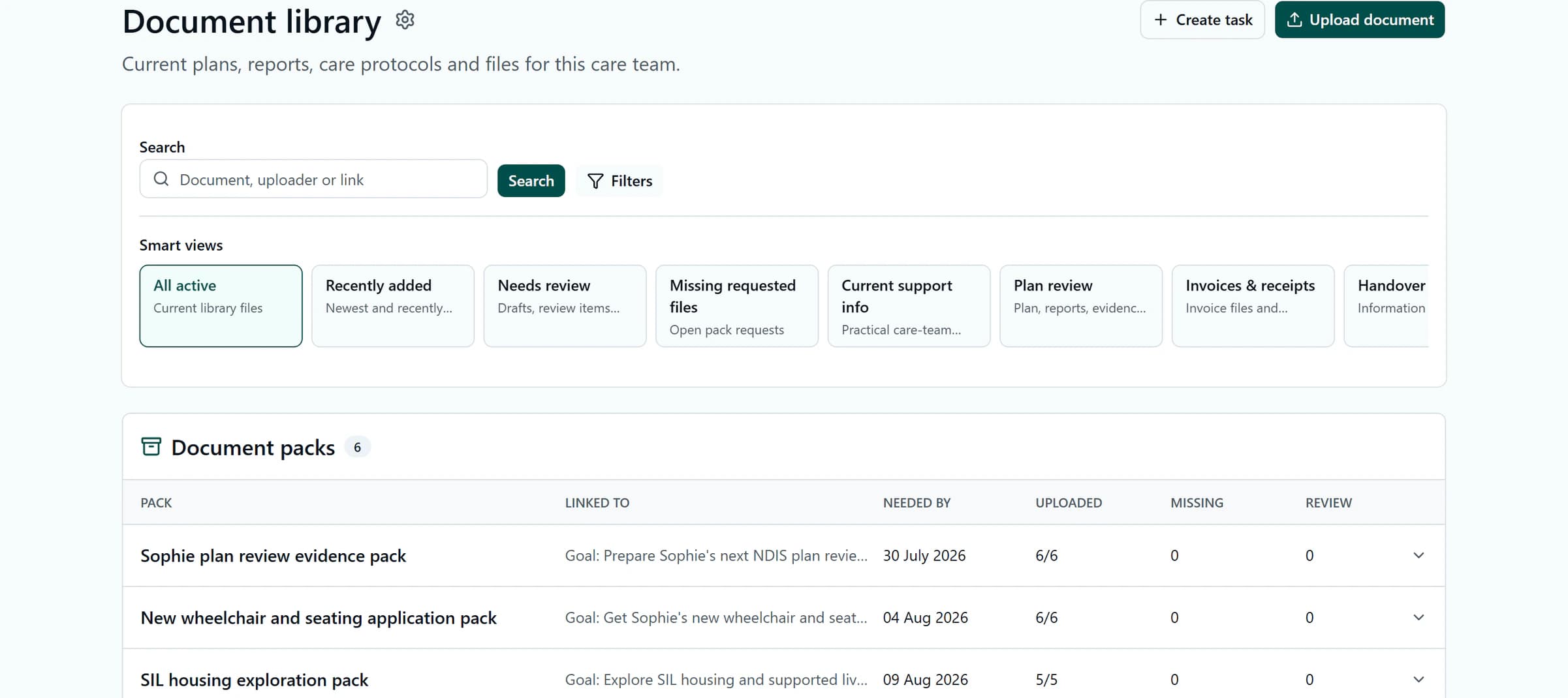
If several people are contributing, Kinovo can keep the shared goal, agreed actions, waiting reasons and relevant files together. After creating an account, you can add a goal such as Prepare for plan reassessment, agree who will take each next step and invite the people involved. Each contributor can maintain their part. This is manual coordination; downloading or using the tracker does not automatically import it, send evidence or create a request.
Choose a Free account or review optional paid plans. No card is needed for a Free account or no-card trial.
Questions people ask before using the tracker
What evidence do I need for an NDIS plan reassessment?
Start with the purpose and the participant's situation, rather than a report from every professional. A participant-requested reassessment needs the NDIA request form and evidence of a significant, ongoing change. For a scheduled process, ask your my NDIS contact what information is needed. This tracker helps organise the contributions; it is not an official evidence checklist.
Do I need a new report from every provider?
There is no universal list of reports for every participant. Ask what question each report would answer, whether current information already addresses it and whether an update is appropriate. Confirm relevance, cost, assessment needs and timing before commissioning more work.
What if a report is late or I have incomplete information?
Tell your my NDIS contact what is outstanding and when the contributor expects it. Ask what can be provided now, how later information would be handled and whether any date changes. Do not assume an incomplete reassessment request will be accepted or a deadline extended. Record the answer and the next agreed follow-up.
How early should I ask for a professional report?
Ask the professional what appointments, information, consent, cost and lead time are involved. Explain the date you need to review it and ask what timing they can agree to. Leave time for the participant to review the relevant information and for questions or corrections where possible.
Can a support coordinator request reassessment for me?
For significant changes outside a regular check-in, the current reassessment form must come from the participant, plan nominee or child representative. A provider cannot make that request on the participant's behalf, even with consent. Helping prepare evidence or providing a report is different. Variation requests have different rules; check the process with the NDIA.
Can I use the checklist without Kinovo or an email address?
Yes. The complete page, printable PDF and editable spreadsheet are available directly. You can use the tracker in your existing arrangements. Kinovo is an optional place to coordinate a shared goal, agreed actions, waiting reasons and relevant files with invited team members.
Does Kinovo send the tracker to the NDIA or guarantee funding?
No. Creating an account or recording work in Kinovo does not lodge a reassessment request or send evidence to the NDIA. Use the current official submission process. A completed tracker, reviewed report or receipt does not guarantee reassessment, funding or any particular decision.
Using this in a resource library, course or client pack?
You are welcome to link to this page or share the unchanged Kinovo PDF with attribution. No reciprocal link, preferred keyword, referral arrangement or recommendation of Kinovo software is expected. Please keep the scope note, attribution and current version visible. This permission is not a Creative Commons licence and does not permit altered or rebranded copies.
Suggested neutral description
A free NDIS plan review checklist and editable evidence tracker for organising relevant reports, agreed follow-up, current files and unanswered questions before a plan reassessment.
Suggested citation
Kinovo. NDIS Plan Review Checklist and Reassessment Evidence Tracker. Updated 23 October 2026. https://www.kinovo.com.au/resources/plan-review-evidence-tracker